How to Get More Dental Patients — The SEO System That Works
Most US dental practices rely on ads, referrals, and hope. The ones filling their schedules consistently are ranking in Google Maps top 3 — and doing it through SEO, not spend.
- ✓ Google Maps top 3 = 70% of all dental clicks
- ✓ 8–15 new organic patient enquiries per month by month 6
- ✓ Rankings you earn compound — ads stop the moment you pause
- ✓ US dental practices only — built around your market
No commitment. Takes 2 minutes. We show you exactly why your practice isn't growing.
Why Most Dental Practices Struggle to Get New Patients
If your dental practice is not getting enough new patients, you are almost certainly not alone — and the cause is almost never what you think it is. Most dentists assume the problem is their marketing budget, their location, or simply bad luck. The actual cause is almost always one of three things: Google cannot find you, Google does not trust you, or a competitor has done the work to appear above you in local search.
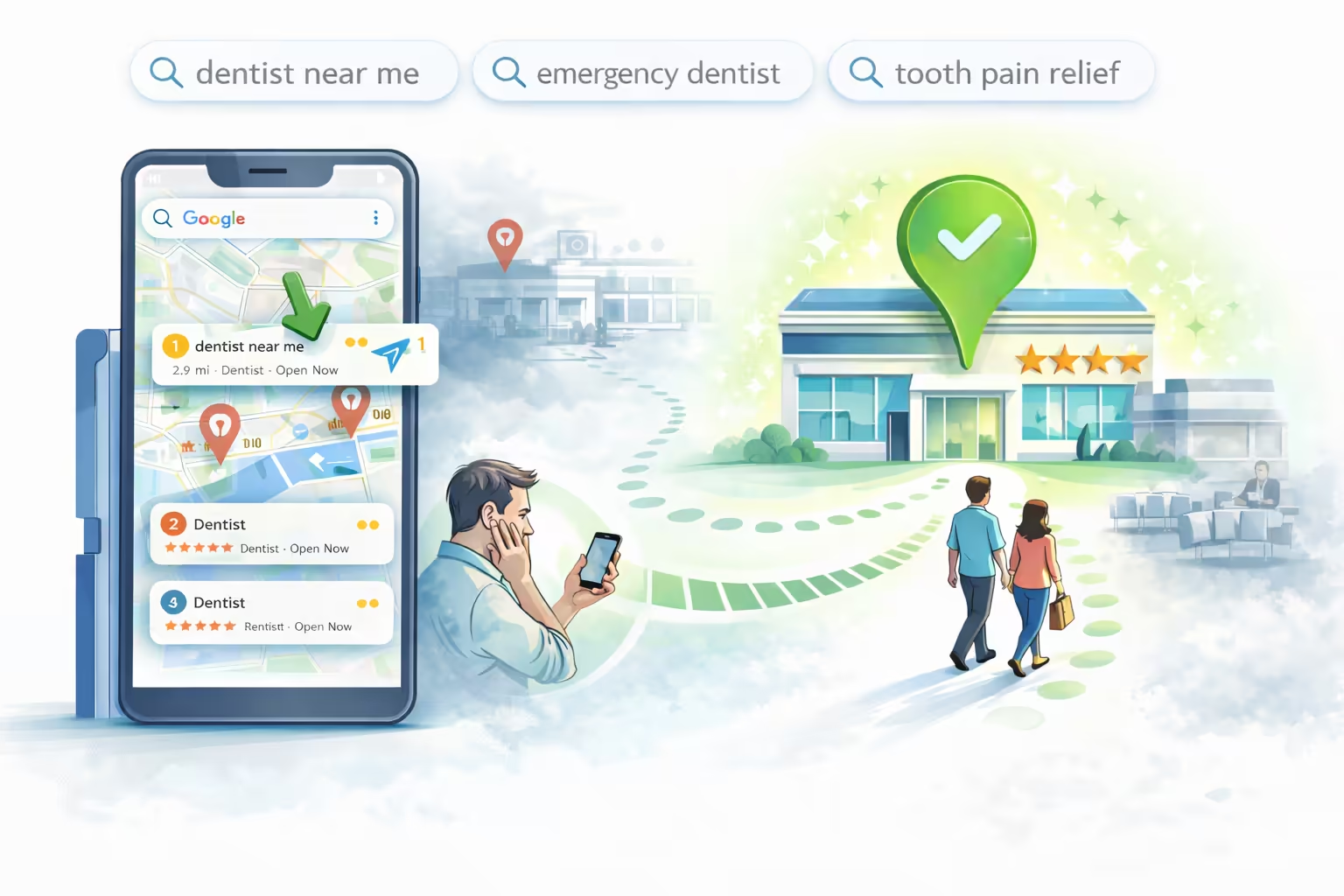
Here is the reality of how dental patients find a practice today. Referrals have declined steadily for a decade. Patients move, change insurance, and search online for a new dentist — they do not ask a friend. When they search, they type "dentist near me" or "dentist in [city]" into Google, and they click one of the first three results in the Maps Pack. They do not scroll past it. They do not go to page 2. They call the practice at position 1, 2, or 3.
If your practice is not in those three positions, you are invisible — not because your practice is not good, but because the signal Google uses to decide who appears there has not been built consistently for your listing.
Your Google Business Profile has the wrong category, missing attributes, or no activity — so Google ranks competitors above you for every "dentist near me" search in your zip code.
Patients searching "dental implants [city]" or "Invisalign near me" find a competitor with a dedicated page. Your homepage cannot rank for every procedure — each one needs its own optimised page.
Google ranks local practices based on relevance, proximity, and prominence. Prominence comes from citations, backlinks, and reviews — signals that take consistent monthly work to build and maintain.
Why SEO Is the Only Channel That Compounds Over Time
Dental practices have more marketing options today than ever before — Google Ads, Facebook Ads, direct mail, billboards, referral programmes, social media. Most dental practice owners have tried several of them. Very few have found a channel that grows on its own.
The reason is straightforward: every channel except SEO requires continuous spending to maintain results. The day you stop paying for Google Ads, the calls stop. The day you stop sending mailers, the response stops. SEO is the only channel where the work you do in month 3 still delivers patients in month 18, month 24, and beyond — without paying per click.
The compounding effect is what separates SEO from every other dental marketing channel. A practice that starts investing in SEO today builds an asset that grows in value every month. A practice that only runs ads is renting its patient pipeline — and the rent never stops.
The DentistsRank System
How Our Dental SEO System Gets You More Patients
Five interconnected pillars. Each one built before the next begins. Together they create the ranking authority that puts your practice in front of patients who are actively searching right now.
How to Attract New Dental Patients From Google Maps
The Google Maps local pack — the block of three dental practices shown with a map at the top of search results — is the single most important piece of digital real estate for any US dental practice. It captures 70% of all clicks for "dentist near me" and "dentist in [city]" searches. Patients looking at this block are ready to book. They are not browsing. They are choosing between three practices.
The practices in those three positions are not there by accident. Google determines Maps Pack rankings using three core signals: relevance (does your GBP match what the patient is searching for?), distance (how close are you to the searcher?), and prominence (how established and trusted is your practice online?). Relevance and prominence are both fully controllable through local SEO. Distance is fixed.
Correct dental category, all service attributes set, hours accurate, photos uploaded, description keyword-optimised. Most practices are set up incorrectly — wrong category alone can drop you out of the top 10.
Weekly posts, monthly Q&A updates, attribute reviews, and photo additions. Google rewards active profiles. A GBP set up once and never touched is a Maps ranking that slowly declines.
Consistent Name, Address, Phone (NAP) across Healthgrades, Zocdoc, ADA listings, Yelp, and 50+ dental and health directories. Inconsistent citations are one of the top reasons dental practices fail to rank in Maps.
Volume and recency of Google reviews are direct Maps ranking signals. We build a simple, repeatable system for generating reviews from existing patients — the single most overlooked factor in Maps Pack rankings.
For the complete breakdown of every local ranking signal and how we manage them, see our dedicated guide to local SEO for dentists.
What to Expect — Month by Month
The most common question from dental practice owners before starting SEO: "How long until I see more patients?" Here is the honest, specific answer.
At month 6, a typical dental practice generates 8–15 new patient enquiries from organic search. At an average case value of $800–$1,200, that is $6,400–$18,000 in monthly patient value — from a channel with zero cost per lead.
Dental Practice Growth Strategies — What Actually Works
Dental practice growth strategies fall into two categories: channels that generate activity and channels that generate patients. Most of the marketing advice dentists receive focuses on the first category — more social posts, more emails, more mailers. None of those channels puts your practice in front of a patient who is actively searching for a dentist right now.
The dental practices growing most consistently in 2026 are doing three things: ranking in Google Maps top 3 for their primary location keywords, owning individual organic rankings for their highest-value procedure keywords, and converting that traffic with clear, patient-focused pages that make booking obvious. This is not a complicated formula — but it requires consistent, dental-specific execution every month.
70% of dental clicks. Sustainable. Zero cost per patient once established. Requires consistent GBP management, citations, and local authority building.
Patients searching "dental implants [city]" are ready to spend $3,000–$6,000. Individual optimised pages for each high-value procedure capture this traffic directly.
Effective while organic rankings are building. But treat it as a bridge, not a foundation — the cost per patient from ads never drops below $40–$120.
Volume and recency of Google reviews directly affect Maps Pack rankings. A structured monthly review process is one of the highest-ROI activities any dental practice can do.
We work exclusively with US dental practices. If you want to understand our full approach to dental practice growth — including how we position your practice as a specialist dental SEO agency client — the overview covers exactly how every piece fits together.
Find Out Exactly Why Your Practice Is Not Getting More Patients
Start with a free dental SEO audit. We analyse your site, your Google Business Profile, your local rankings, and your top competitors — then show you the specific fixes that will drive new patients.
Get My Free Dental SEO AuditHow to Get More Dental Patients — Frequently Asked Questions
How do I get more patients in my dental office?
The most effective way to get more patients in your dental office is to rank in Google Maps top 3 for local dental searches. 70% of patients searching "dentist near me" click one of the top three Map Pack results. To rank there, you need a fully optimised Google Business Profile, consistent local citations across dental directories, and an SEO-optimised website. This is a system — not a one-time task. The practices with the most consistent flow of new patients have invested steadily in local SEO over 6 to 12 months.
What is the fastest way to attract new dental patients?
Google Ads can get your phone ringing within days, but you pay for every single call — and the moment you stop, so does the volume. The fastest way to build a sustainable flow of new dental patients is to combine Google Ads in the short term with SEO as the long-term foundation. Most dental practices see their first measurable ranking movements from SEO within 60 to 90 days. By month 6, practices in mid-competition US markets are generating 8 to 15 new organic patient enquiries per month — at zero cost per lead.
How long does it take to get more dental patients from SEO?
Most dental practices see their first ranking movements within 60 to 90 days of starting SEO. Maps Pack visibility typically improves within the first 60 days for practices with a well-managed Google Business Profile. Full organic rankings for competitive procedure terms take 4 to 6 months. The critical point is that SEO compounds — each month of consistent work adds to your authority, and the rankings you earn continue to deliver patients indefinitely without any ongoing ad spend.
How many new patients can I expect from SEO per month?
Dental practices in mid-competition US markets that rank in Google Maps top 3 typically generate 8 to 15 new patient enquiries per month from organic search alone by month 6. Practices targeting high-intent procedure keywords like dental implants or Invisalign often see higher numbers because those patients are further along in their decision and ready to book. At an average case value of $800 to $1,200, that is $6,400 to $18,000 in monthly patient value from a channel with zero cost per lead.
What is the best marketing strategy for a dental practice?
The best dental marketing strategy combines Google Business Profile optimisation, local SEO, and procedure-specific content — all focused on ranking in Google Maps top 3. This is more effective than social media, direct mail, or referral programmes because it captures patients at the exact moment they are actively searching for a dentist. Unlike ads, the rankings you build through SEO are permanent assets. A dentist who invests in SEO consistently for 12 months owns their local search presence. A competitor who only runs ads starts from zero the day they stop paying.
Does SEO really work for dentists?
Yes. SEO is the highest-ROI patient acquisition channel available to dental practices. 77% of patients search online before booking a healthcare appointment. For dentists, Google Maps top 3 results receive 70% of all clicks for "dentist near me" searches. Practices that rank there fill their new patient slots consistently without paying per click. The practices that say SEO doesn't work have almost always worked with a general agency applying generic frameworks — not a dental-specific system built around the signals that actually move dental Maps rankings.
How do dentists get new patients from Google?
Dentists get new patients from Google through two channels: the Google Maps local pack (the top 3 results shown for "dentist near me" searches) and organic blue-link results for procedure keywords like "dental implants [city]". To rank in both, you need a fully optimised Google Business Profile with dental-specific categories, a website with properly structured service pages for each procedure, consistent local citations across dental and health directories, and authority backlinks from relevant sources. See our detailed guide to local SEO for dentists for the complete signal breakdown.
What should I do if my dental practice isn't getting new patients?
The first step is a full SEO audit — not a guess. The most common causes are: your Google Business Profile has the wrong category or missing dental service attributes, your website has no dedicated pages for the procedures patients are searching for, your NAP information is inconsistent across directories, or a technical issue is preventing Google from indexing your pages. A dental SEO audit identifies the exact cause. DentistsRank provides a free dental SEO audit for US practices — we diagnose before we prescribe.
How do I grow my dental practice without spending more on ads?
The way to grow your dental practice without increasing ad spend is to build your organic rankings through SEO. Every ranking you earn continues to deliver patients without ongoing cost. A practice that reaches Google Maps top 3 for its primary location keywords receives patients for free — patients who would have cost $40 to $120 each through Google Ads. The investment is in building those rankings over 6 to 12 months. After that, the channel is essentially self-sustaining, growing in volume as your authority compounds month after month.
Should a new dental practice invest in SEO to get more patients?
Yes — and new dental practices have a significant advantage. Starting SEO in year one means your domain authority, local citation profile, and content depth all grow from the beginning. Practices that delay SEO until year two or three are building their organic presence while already paying for ads. The earlier you start, the sooner you compound. A dental practice that builds its SEO foundation in year one typically achieves Maps top 3 rankings by year two — at which point the organic channel delivers consistent new patients at zero cost per lead.
Every Day You Wait, a Competitor Gets
the Patient Who Was Searching for You.
The dental patients in your area are searching right now. They will call one of the first three practices that appears in Google Maps. Start with a free dental SEO audit — we will show you exactly where you stand, who is outranking you, and the specific steps to change it.
No commitment. No sales call. A clear, specific picture of your dental SEO health — delivered within 24 hours.
Get Your Free Dental SEO Audit TodayUS dental practices only · Responds within 24 hours · No agency jargon